

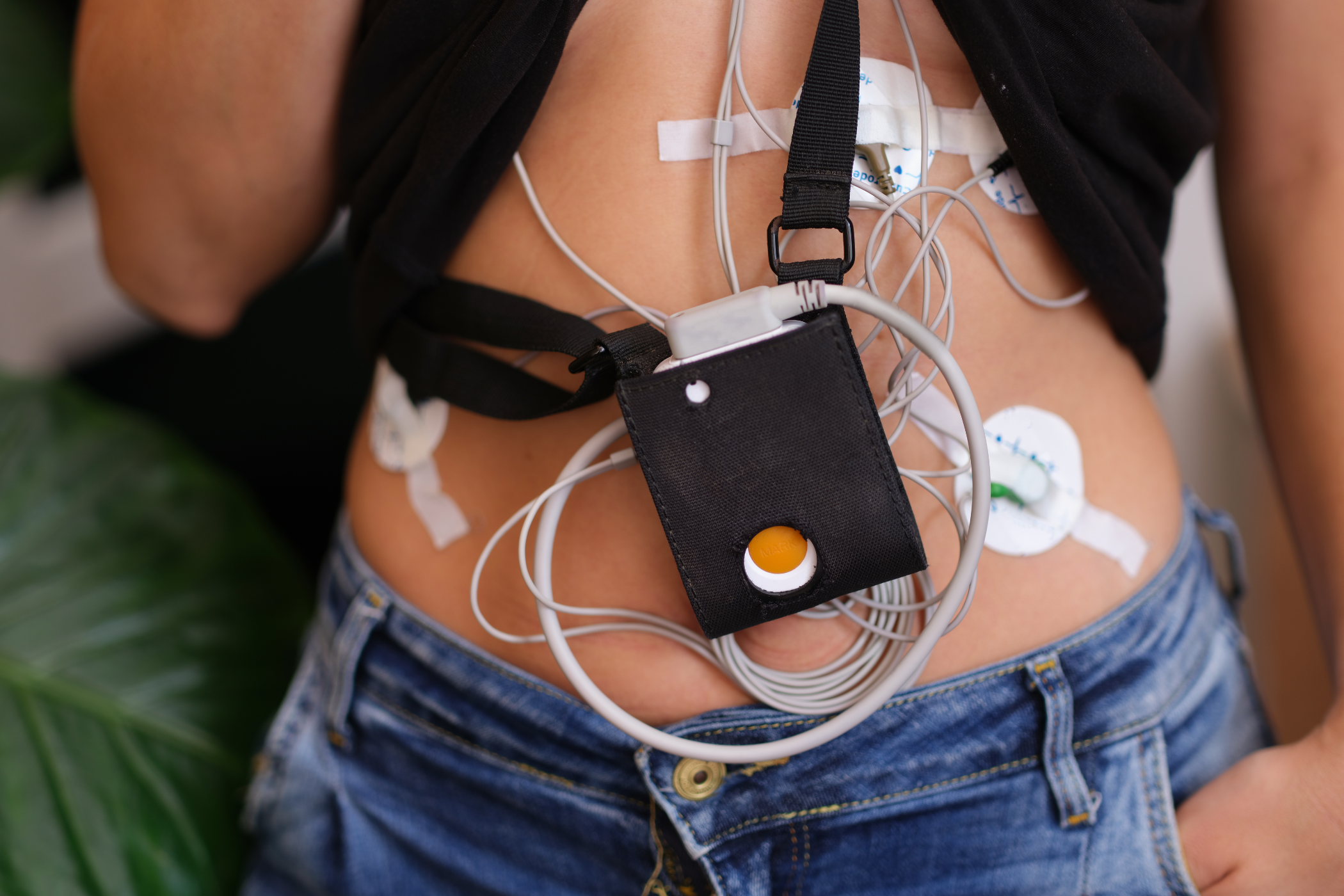
What is an ECQ Holter monitor?
An ECG Holter monitor is a small, portable device that continuously records the electrical activity of your heart over an extended period, usually 24 to 48 hours, while you go about your normal daily life. It works on exactly the same principle as a standard ECG performed in clinic, but instead of capturing a few seconds of your heartbeat, it records every single beat over a much longer window. Small sticky electrodes are placed on the chest and connected to a lightweight recorder worn on a belt or under clothing. The purpose is to catch heart rhythm problems that come and go and might not show up during the brief snapshot a standard ECG provides.
This is why a Holter monitor is so valuable. Many heart rhythm disturbances are intermittent, appearing for a few minutes and then settling, so a resting ECG lasting under a minute can easily miss them. In our experience at our Warwick Park rooms in Tunbridge Wells, the Holter monitor is one of the most useful tests we have for getting to the bottom of symptoms such as palpitations, dizziness, and blackouts. From working with patients across Kent and East Sussex since 2006 at West Kent Cardiology Partnership, we have found that recording the heart over a full day and night, during ordinary activity and sleep, frequently reveals the answer when a one-off ECG has come back normal.
Why a Holter monitor is useful
A standard ECG is excellent when a rhythm problem is present all the time, because it will be captured the moment the recording is taken. The difficulty comes with intermittent problems. If your heart only misbehaves occasionally, the chance of it doing so during a short clinic recording is small.
A Holter monitor solves this by recording continuously, which dramatically increases the likelihood of capturing an intermittent arrhythmia. Just as importantly, you keep a simple diary of your symptoms and activities while wearing it, so that any moment you feel a palpitation, dizziness, or breathlessness can be matched precisely against what your heart was doing at that exact time. In our experience, this correlation between symptoms and the recorded trace is often the single most useful piece of information the test provides.
When a Holter monitor is recommended
There are several situations where we recommend a Holter monitor. The most common is to investigate palpitations, whether these feel like a racing, pounding, fluttering, or skipping sensation. Patients who notice their heart racing when lying down or at other specific times are often good candidates, because the monitor can record exactly what is happening during those episodes.
It is also used to investigate unexplained dizziness, light-headedness, or fainting, which can be caused by the heart beating too slowly, too quickly, or pausing. A Holter monitor is one of the key tests for detecting atrial fibrillation, particularly the intermittent form that comes and goes, and it is frequently used after a stroke to check for atrial fibrillation as a possible underlying cause. Other uses include assessing how well a known rhythm problem is being controlled by medication, checking that a pacemaker is working correctly, and investigating episodes of a slow heart rate.
What to expect when wearing one
Fitting a Holter monitor is quick, straightforward, and painless. A few small adhesive electrodes are placed on your chest, and in some cases a small amount of chest hair may need to be trimmed so they stick well. The electrodes connect by thin wires to the recorder, which is about the size of a small mobile phone and can be clipped to a belt or worn in a pouch. Newer devices may be a single small patch worn on the chest with no wires at all.
Once it is fitted, you carry on with your normal routine. In fact, it is important to do so, because the aim is to reproduce the circumstances in which your symptoms usually occur. You will be asked to keep the device dry, which with the traditional type usually means avoiding showering or bathing while wearing it, and to note down in a diary the time of any symptoms along with what you were doing. After the recording period, you simply return the device so the data can be analysed.
Different lengths of monitoring
The right duration of monitoring depends on how often your symptoms occur. A standard Holter monitor records for 24 or 48 hours, which is ideal for symptoms that happen most days. For symptoms that appear less frequently, a longer recording is needed, such as a 7-day cardiac event recorder, which the patient can also activate when they feel an episode. For very infrequent but significant symptoms, an implantable loop recorder that sits under the skin and monitors for months or years may be recommended.
In our experience, matching the length of monitoring to how often symptoms occur works better than fitting a 24-hour recorder for everyone, because a short recording has a low chance of capturing a problem that only happens once a week or once a month. From working with patients, we have found that taking a careful history first, to understand how often and in what circumstances symptoms occur, allows us to choose the right type of monitor at the outset and avoid the frustration of a normal result that has simply missed the event.
What happens to the results
Once the recording is complete, the data is downloaded and analysed in detail, with your symptom diary used to correlate any episodes you noted against the trace. One of our consultant cardiologists reviews the findings and discusses them with you, explaining whether any rhythm problem was found, what it means, and what the next steps are. Depending on the result, this might involve reassurance, a change in medication, further tests such as an echocardiogram, or in some cases a treatment such as ablation or a pacemaker.
How we use it
At our Tunbridge Wells clinic, Holter monitoring is arranged and interpreted by the same consultant who assesses you, so there is continuity from your first appointment through to the explanation of your results. As the only dedicated private cardiac facility in the West Kent area, we are able to offer the full range of monitoring options, from a 24-hour Holter to extended recorders, and to move quickly to any further investigation that the results indicate.
Conclusion
An ECG Holter monitor is a simple, non-invasive, and highly effective way of recording the heart over an extended period to catch intermittent rhythm problems that a standard ECG can miss. It is the test of choice for investigating palpitations, unexplained dizziness or fainting, and suspected atrial fibrillation, and the diary you keep while wearing it is often as valuable as the recording itself. For most people it is easy to wear and causes little disruption to daily life.
If you have been experiencing palpitations, dizziness, or blackouts and would like them properly investigated, you can contact us, Dr Clive Lawson and Dr Derek Harrington at West Kent Cardiology Partnership, to arrange a consultation at our Tunbridge Wells clinic, or call us directly on 01892 526726.
